Written & reviewed by Dr. Nisha Bali
Founder, Dental Brasstacks · 25+ years in Dentistry
A patient walked into my clinic last week holding a small ziplock pouch. Inside it, wrapped in a tissue, was his own crown.
"It came off while I was eating," he said, almost apologetically. "Can you just stick it back?"
He wasn't in pain. He wasn't worried. If anything, he looked mildly inconvenienced — the way you'd feel if a shirt button popped off, not the way you'd feel if something inside your body had quietly been failing for years.
That calm is what stayed with me long after he left.
What "just stick it back" actually revealed
I picked up the crown first. A porcelain-fused-to-metal restoration, the ceramic chipped along one edge — not from this fall, but from older, repeated stress. Crowns don't usually chip like that without a story behind them.
Then I looked inside his mouth.
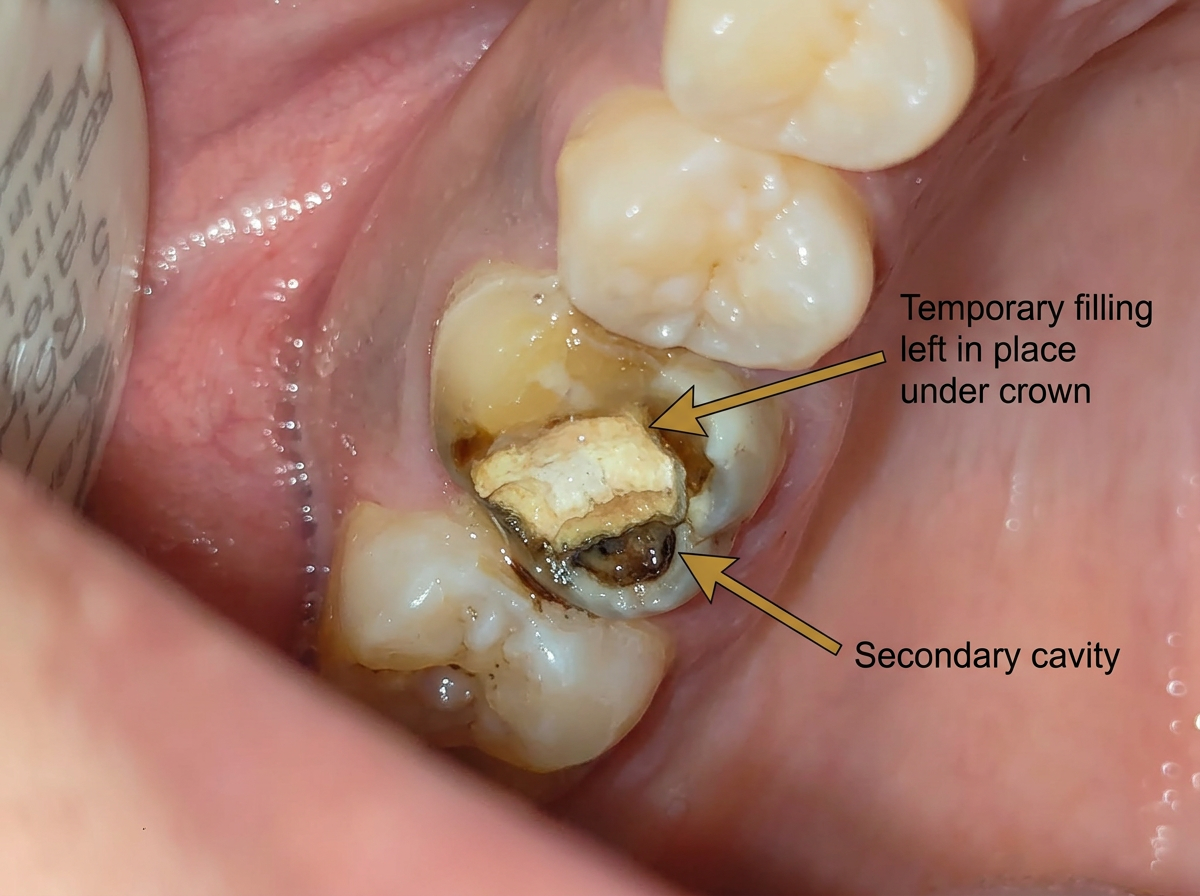
The tooth that held the crown wasn't really a finished tooth at all. It had a temporary filling sitting underneath — the kind meant to last weeks, not years. Someone had done a root canal on this tooth at some point, capped it with a provisional material, and then simply cemented a permanent crown straight over it. No final restoration. No real seal. Just a crown, sitting on a placeholder, for what looked like a long time.
Underneath that temporary filling, a secondary cavity had quietly formed — decay creeping in through the gaps a temporary filling was never built to keep out.
And when I checked the tooth right next to it, almost out of habit, it had a cavity too. Untouched. Unmentioned. Sitting there, growing, with nobody watching it.
This wasn't one mistake. It was a sequence of shortcuts, each one invisible to the patient, each one compounding the next.
The most dangerous symptom is no symptom at all
Here is the part that should worry every reader of this article more than the clinical details do: the patient felt nothing.
No sensitivity. No throbbing. No reason to ever go back and ask questions. In his mind, the dentist who did this work was good — because good, to a patient without dental training, often just means "didn't hurt." He had, by his own admission, referred friends and family to that same clinic. A painless experience, presumably, made for a five-star recommendation.
But a tooth can be silently failing while feeling perfectly fine. Decay doesn't always announce itself. A crown placed over an incomplete, unsealed foundation can sit there for years, doing damage you can't feel — until the day it simply comes off in your hand, like it did for him.
Why this keeps happening in India
I want to be careful here, because this isn't about vilifying any one dentist. It's about naming a structural problem that every Indian patient is quietly exposed to.
There is no dental insurance ecosystem in India that requires documented treatment plans, second opinions, or outcome audits the way it does in many other countries. There is no routine external supervision of what happens inside an individual private clinic, chair to chair, patient to patient. A dentist's reputation is built almost entirely on word of mouth, Google star ratings, and Instagram reels — none of which can actually see what's happening under a crown, inside a root canal, or beneath a "temporary" filling that quietly became permanent by neglect.
Families often pick a dentist once, then send everyone — parents, children, in-laws — to that same person for decades, because trust, once given, is rarely re-examined. Social proof becomes a substitute for clinical proof. And because there's so little visibility into what "good work" actually looks like radiographically, patients have no real way to evaluate whether they're being well cared for or just being treated comfortably.
The result is exactly what walked into my clinic in a ziplock pouch: dentistry that felt fine, looked fine on the surface, and was quietly failing underneath.
So what can a patient actually do?
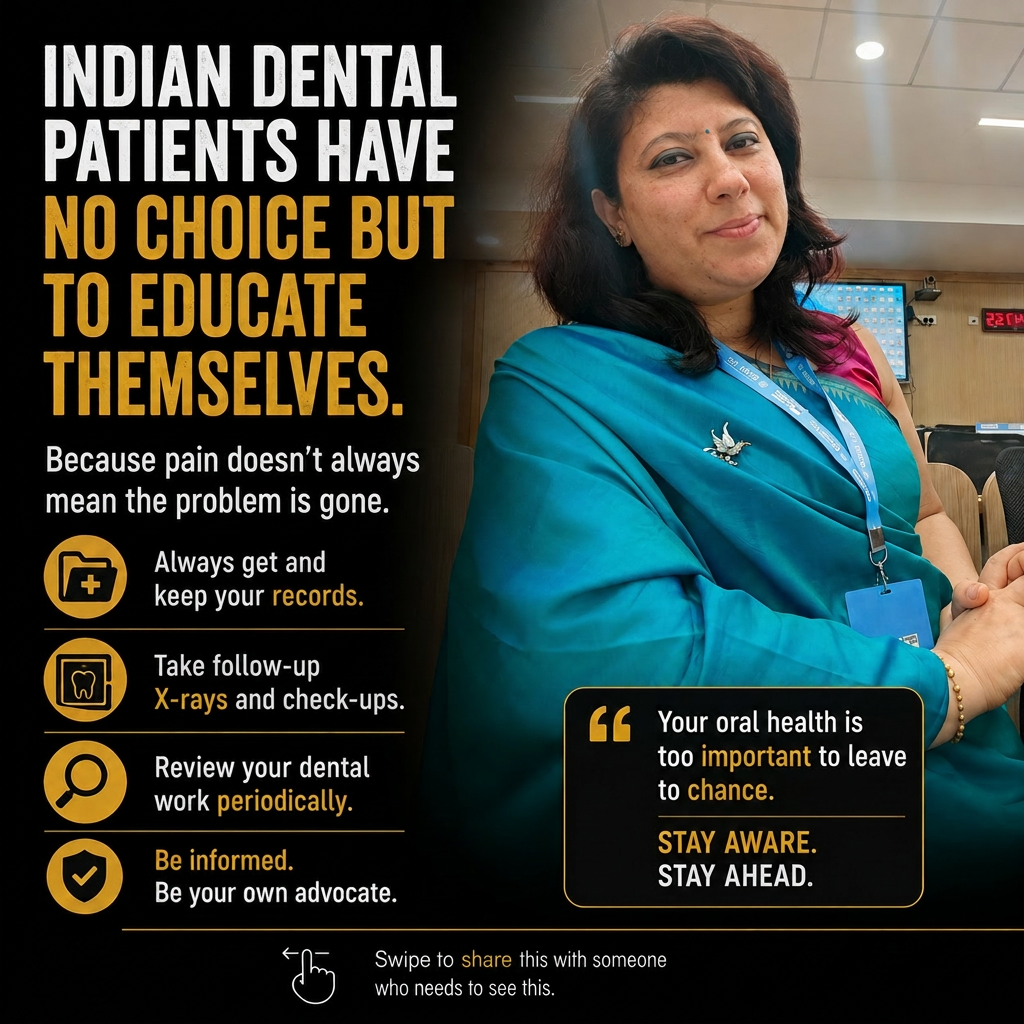
I don't say any of this to make people fearful of dentists. I say it because in the absence of system-level accountability, the patient has to become their own quiet auditor. A few things I'd ask every patient reading this to start doing, regardless of which dentist you see — including me:
Ask for and keep your own records. Treatment notes, materials used, and dates. If a clinic is reluctant to give you this, that reluctance is itself information.
Get follow-up X-rays after major work — root canals, crowns, fillings — not just at the time of treatment, but months and years later. A radiograph can show you what no amount of "it doesn't hurt" ever will.
Don't let "painless" mean "healthy." Schedule routine check-ups even when nothing feels wrong. Especially when nothing feels wrong.
Treat a second opinion as normal, not as an insult to your dentist. Good dentistry holds up to scrutiny. It welcomes it.
Understand the difference between a temporary and a final restoration, and ask your dentist directly which one is in your mouth right now, and for how long it's meant to stay there.
None of this requires a dental degree. It requires curiosity, and the willingness to ask one more question before you trust blindly — even with someone the whole family swears by.
The real work of rescue dentistry
A large part of my practice, after 25 years, has quietly become this: untangling the consequences of dentistry that felt fine at the time. Recementing crowns that should never have been cemented the way they were. Reopening teeth that were sealed shut around problems instead of solving them.
It is rarely dramatic. It is rarely painful for the patient, until suddenly it is. And it is almost always preventable, if someone — anyone — had asked one more question along the way.
So ask it. Your smile is not obligated to hurt before it deserves your attention.
— Dr. Nisha Bali, Founder, Dental Brasstacks
Dental Brasstacks · Specialist Rescue & Restoration Clinic · Vipul World, Sector 48, Sohna Road, Gurugram · WhatsApp 9871110897.
Have a question of your own?
We're happy to answer over WhatsApp before you book — no commitment.
Reach the clinic