
Written & reviewed by Dr. Nisha Bali
Founder, Dental Brasstacks · 25+ years in Dentistry
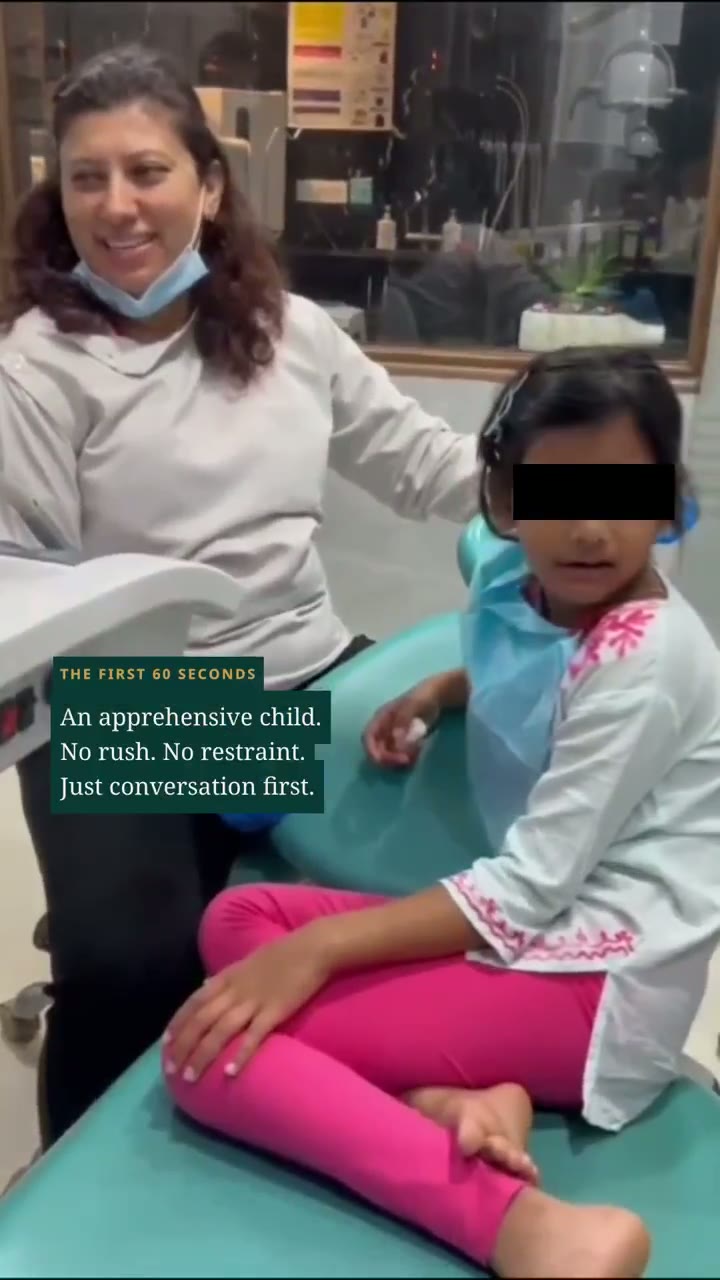
Parents often call me and open with an apology. "She screamed at the last clinic." "He wouldn't even open his mouth." "They told us we need to sedate him." I always say the same thing back: your child is not the problem. A frightened child is behaving exactly as a frightened child should. The job of a paediatric visit is to remove the fear first, and only then to treat the tooth.
In twenty-five years I have treated thousands of children at Dental Brasstacks without pharmacological sedation and without screens. What we use instead is behaviour modification — a set of unhurried, deliberate techniques that build trust in a predictable order. Here is exactly how we do it.
1. The first visit treats nothing
Whenever a child is anxious, the first appointment is a happy visit. We count teeth, ride the chair up and down, look in the mirror, and the child leaves with a sticker and a colouring sheet. Nothing sharp, nothing loud, no treatment. It seems like a wasted appointment to a parent in a hurry. It is the single most valuable thirty minutes of the entire treatment plan, because the child now knows what this room is and that nothing bad happened here.
2. Tell, show, do
Every instrument is introduced in three steps before it ever touches a tooth. I tell the child what it does in their language — the suction is a "thirsty straw", the polishing cup is a "tickly toothbrush". I show it working on their fingernail or on a model. Then, and only then, we do it in the mouth. Nothing is ever a surprise. Surprise is what children are actually afraid of, far more than pain.
3. Positive reinforcement, never coercion
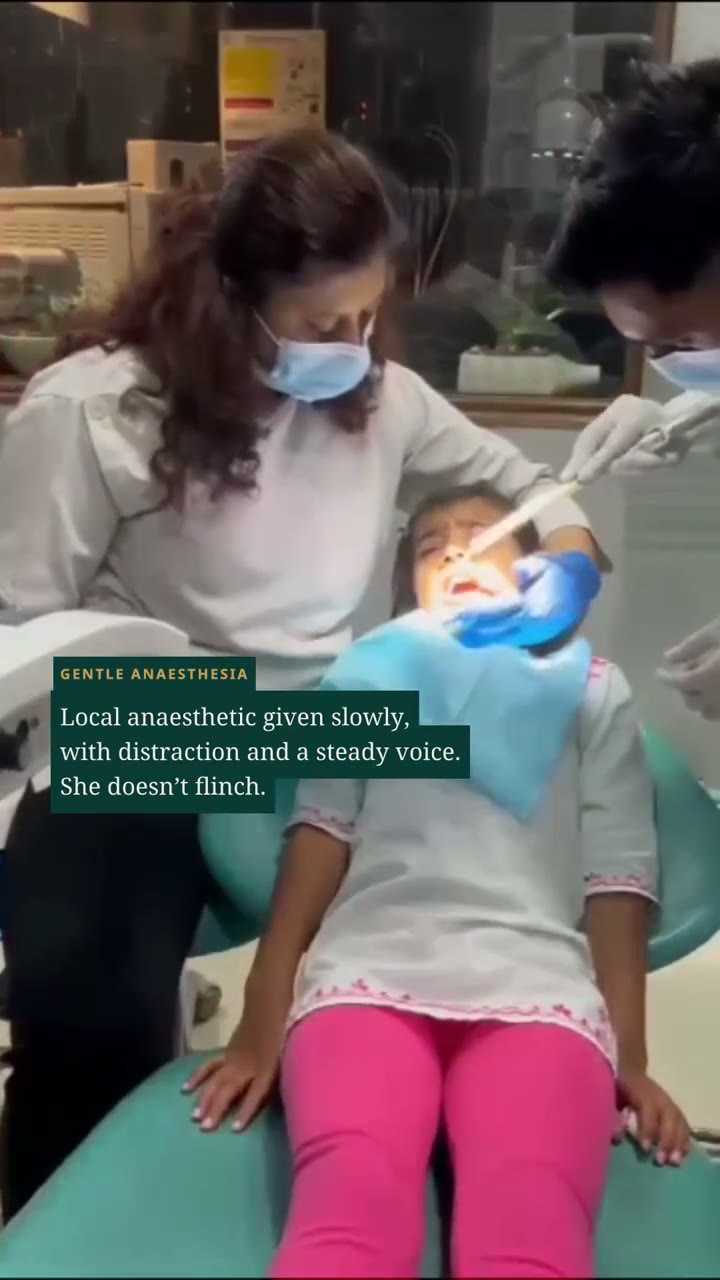
I praise the behaviour, not the child — "your mouth stayed open so still, that helped me so much" works better than "good girl". Praise has to be specific and immediate for a child to connect it to what they did. And we never, ever restrain a child or shame them for crying. A child who is held down learns that adults in white coats cannot be trusted, and that lesson lasts thirty years.
4. Voice control and pacing
Children read tone long before they understand words. A calm, slightly lowered, steady voice settles a room faster than any explanation. I also work slowly — pausing every few seconds, letting them raise a hand to stop me at any time. Giving a child a working stop signal, and honouring it the first time they use it, transfers control back to them. Once they know they can stop me, they almost never need to.
5. Distraction that is real, not digital
We do not hand out tablets. A screen postpones fear; it does not resolve it, and the child arrives just as frightened at the next visit. Our distraction is the clinic itself — the in-house library, the colouring sheets, the carrom board, the indoor waterfall, the rabbits and budgies, the climbing wall. A child who has just fed a rabbit walks into the chair curious instead of braced.
6. Modelling — children copy children
Where a sibling or a friend is being treated, we let the anxious child watch. Seeing another child sit calmly through the exact procedure they are dreading does more than any reassurance from an adult. Older siblings are wonderful for this.
7. Painless technique is part of behaviour management
None of this survives one painful experience. Topical anaesthetic gel is left on long enough to actually work, injections are warmed and delivered very slowly, and we use the smallest needles available. Children forgive noise, water and strangeness. They do not forgive pain — and they remember it precisely.
8. Parents are part of the plan
Two requests I make of every parent. First, never use the dentist as a threat at home. Second, avoid the reassuring words that give the game away — "it won't hurt", "don't be scared", "be brave" all tell a child there is something here to be scared of. Say "the dentist will count your teeth" instead. Parents are welcome in the room, and I simply ask them to let me do the talking once we begin.
What this looks like by the third visit
It looks ordinary, which is the point. Most children who arrived crying are, by the second or third appointment, walking in ahead of their parents, climbing into the chair themselves and telling me which tooth is wobbly. That cooperation is not luck and it is not a lucky child. It is the predictable outcome of a technique applied patiently.
Why we avoid sedation
Sedation and general anaesthesia have a genuine place — very young children with extensive decay, special needs, or genuine medical necessity. But they should be the exception, chosen deliberately, not a shortcut around a child who simply needs more time. A sedated child learns nothing about coping with dentistry. A child guided through it awake learns that they can do hard things — and carries that into every dental visit for the rest of their life.
If your child is anxious, or if a previous visit went badly, tell us when you book. We will plan a happy visit first and take the time it takes.
Have a question of your own?
We're happy to answer over WhatsApp before you book — no commitment.
Reach the clinic